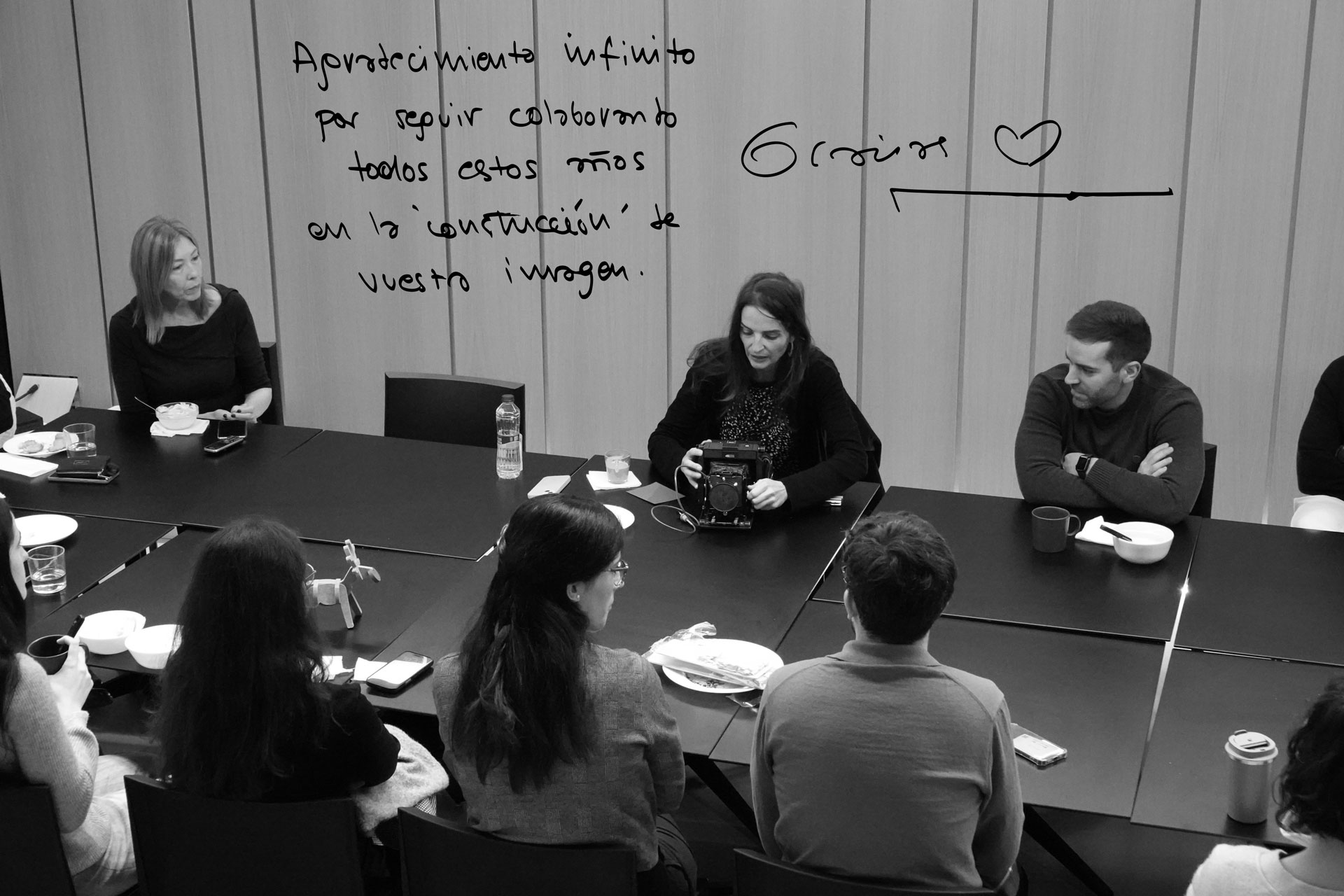
Before the Christmas holidays, the studio opened its doors to a very special creative breakfast. The guest was Mariela Apollonio, an architectural photographer who has been collaborating with the studio for more than a decade and whose gaze has been decisive in the way many projects have been understood, recognised and remembered. Her work is not limited to documenting architecture: she interprets it, constructs it visually and endows it with a distinctive character that has ultimately become part of the studio's own imagery.
Constructing Images to Understand Architecture
Mariela Apollonio does not define herself as a photographer, but as a constructor of images. Her approach always starts from an essential question: what is to be represented. Before pressing the shutter, there is a profound phase of analysis and planning. The development of a storyboard, the study of timing, the precise observation of solar paths and an in-depth understanding of space are all part of an absolute, almost architectural preparation, in which the image is the result of a conscious and carefully considered process.
During the meeting, Mariela shared a particularly revealing gesture: she brought with her her first camera. It was a large-format analogue camera, with holders for large photolithographic plates, which required working with a slowness and precision that are now uncommon. When looking through the viewfinder — a ground glass located at the rear — the image appeared inverted, both vertically and horizontally. Far from being a difficulty, this demanded an exercise in abstraction and spatial understanding that trained the eye and educated composition. That camera alone explained the origin of a way of seeing based on reflection, waiting and conscious decision-making.
The Memory of Spaces
That analogue training was decisive. Technical limitations forced each image to be thought through, the result to be anticipated and the understanding that every exposure carried a specific weight. Today, with digital technology and extensive professional experience, that foundation allows for a greater capacity to react without losing depth or intention. Over time, when reviewing her photographs, Mariela recognises more than images: she remembers having felt each house and each project. Photography thus becomes constructed memory.
Between Identity and Representation
For her, the key lies in never renouncing one's own identity. When an image loses that honesty, it becomes predictable and empty. At the same time, there is a constant tension: photography cannot be excessively authorial and must faithfully represent the studio's work. This balance is one of the great challenges of contemporary architectural photography and also one of the most enriching aspects of the dialogue with the architect.
Recovering The Human Dimension
In a context saturated with renders that aspire to resemble photographs, Mariela asserts the essential difference between representation and built architecture. The overvaluation of digital images generates idealisations that distance us from the real experience of space and lead to dissatisfaction. In response, she advocates a photography that inspires, that is not obvious and that restores the unexpected. Because, ultimately, only when an image has soul is it capable of conveying, without artifice, the true essence of architecture.