Proposal submitted to the open contest organised by EMT Madrid together with the Colegio Oficial de Arquitectos de Madrid (COAM), selected among the eight highest-rated proposals and recognised with an Honourable Mention by the jury.
IDENTITY AND CONTEXT
Landscape, Urban Memory and New Cultural Infrastructure
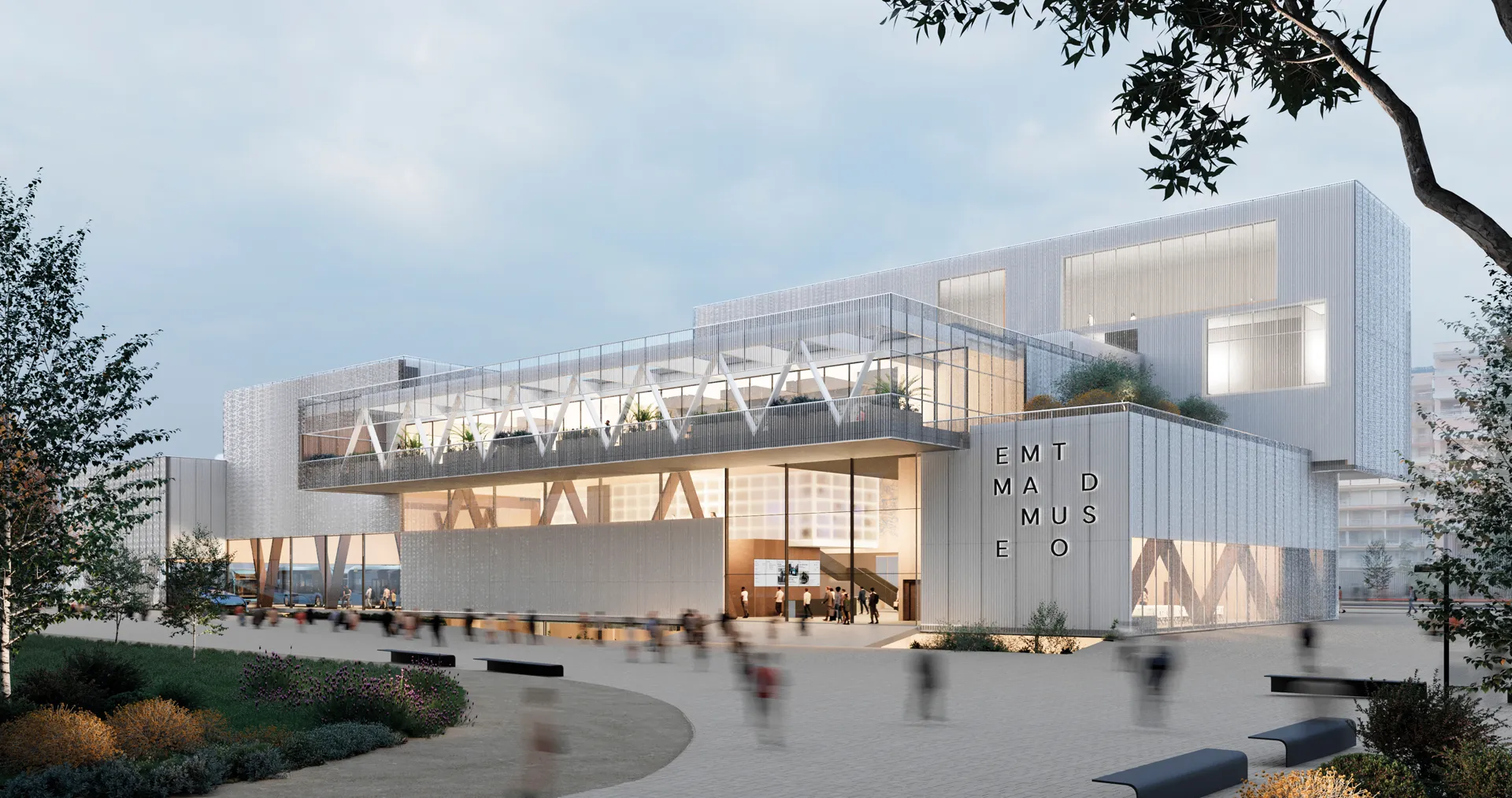
The new EMT Madrid Museum proposal is conceived as an emblematic cultural infrastructure for Madrid, designed not only as an exhibition container but as an active component of the urban and social landscape. Its architecture embraces the collective past associated with public transport and projects it towards a contemporary vision of mobility, understood as a technical, cultural and human phenomenon. Rather than simply exhibiting vehicles, the museum proposes a spatial experience in which buses and their stories are integrated into a dynamic, immersive and educational narrative. It is a museum that does not move, yet is in motion; one that transforms the visitor's experience through space, light, materiality and shared memory.
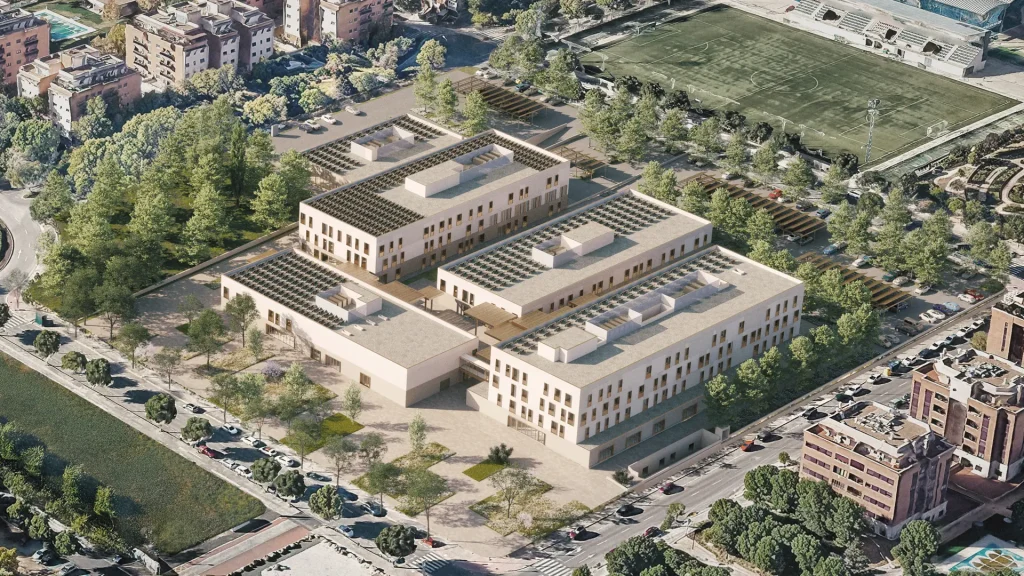
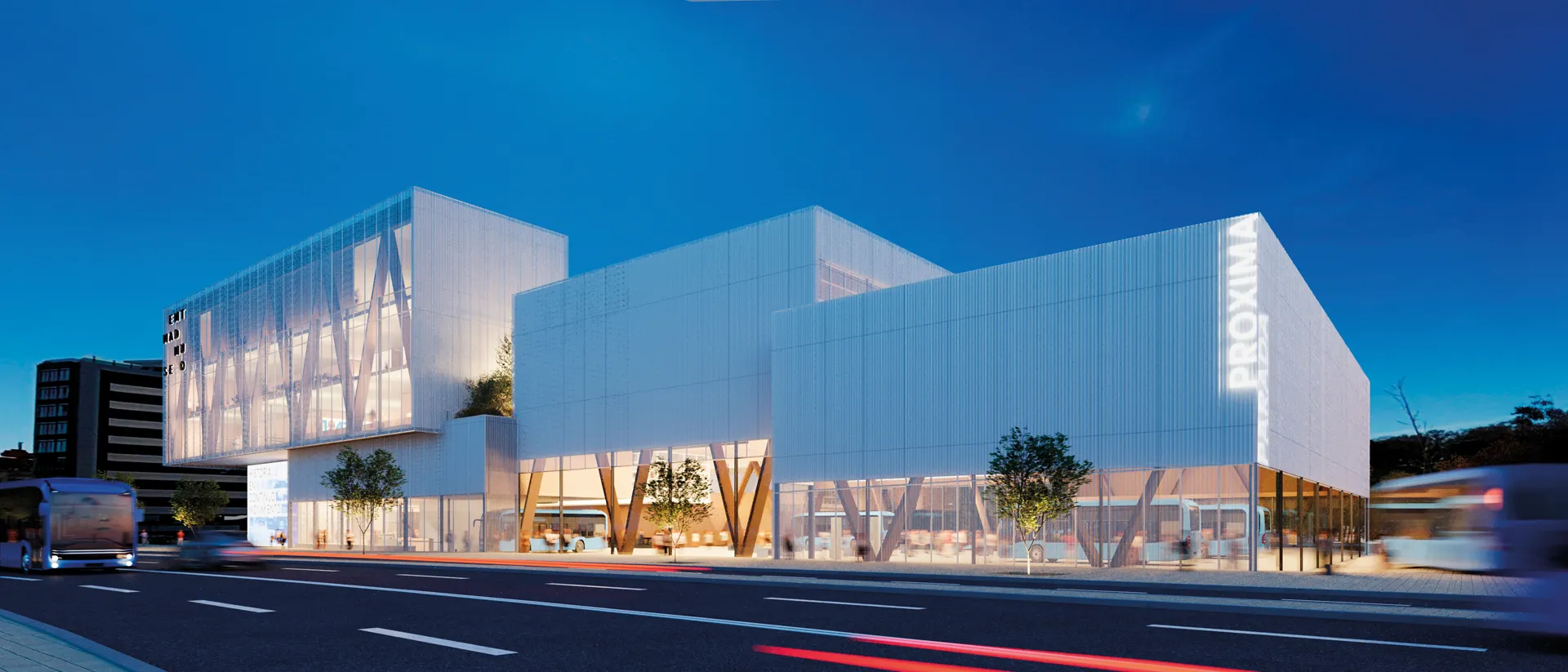
Located on the edge between the Imperial neighbourhood and Madrid Río, the museum acquires a hybrid urban condition. Facing Paseo de los Melancólicos, it presents itself as an institutional, civic and robust façade that consolidates the existing urban network.
Towards the park and the Manzanares riverbed, it opens up as a natural extension of the open space, establishing a new transitional area between the built environment and the landscape. This duality grants the building a strategic position: it becomes a node, a hinge and a sequence between two urban realities that have historically remained separate. The project does not operate as an isolated object; on the contrary, its implantation activates the void left by the former stadium, respecting pre-existing elements and articulating new relationships with the immediate surroundings. Its layout, parallel to the river, refers to the logic of linear infrastructures that have historically structured Madrid (such as railway lines, river courses or tramway routes). In this sense, the museum not only occupies a site of emblematic location, but reactivates it as a place of passage, permanence and connection between city, park and citizens.
The architecture combines structural rationality with evocative capacity. The hierarchical arrangement of the boxes allows each use to develop autonomously, without fragmenting the experience of the whole. The museum is constructed as a flexible system, where each part interacts with each other and the city, without losing its unique character.
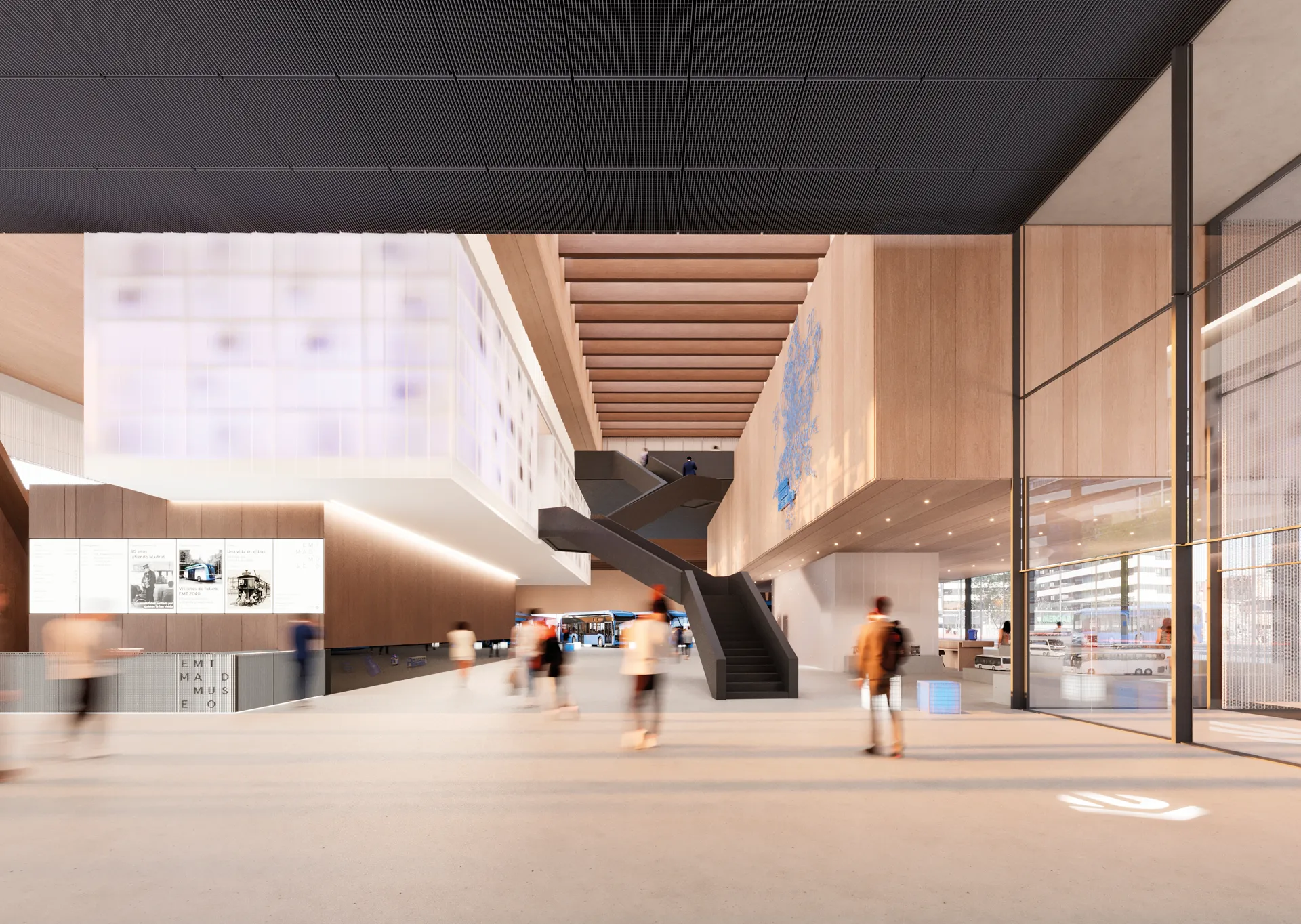
RELATIONSHIPS AND JOURNEY
The Continuous, Accessible and Narrative Space
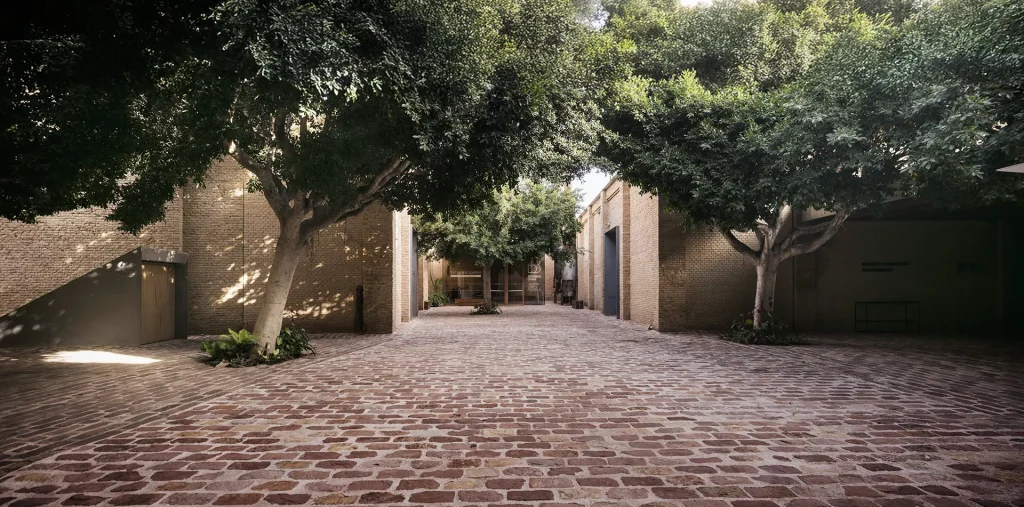
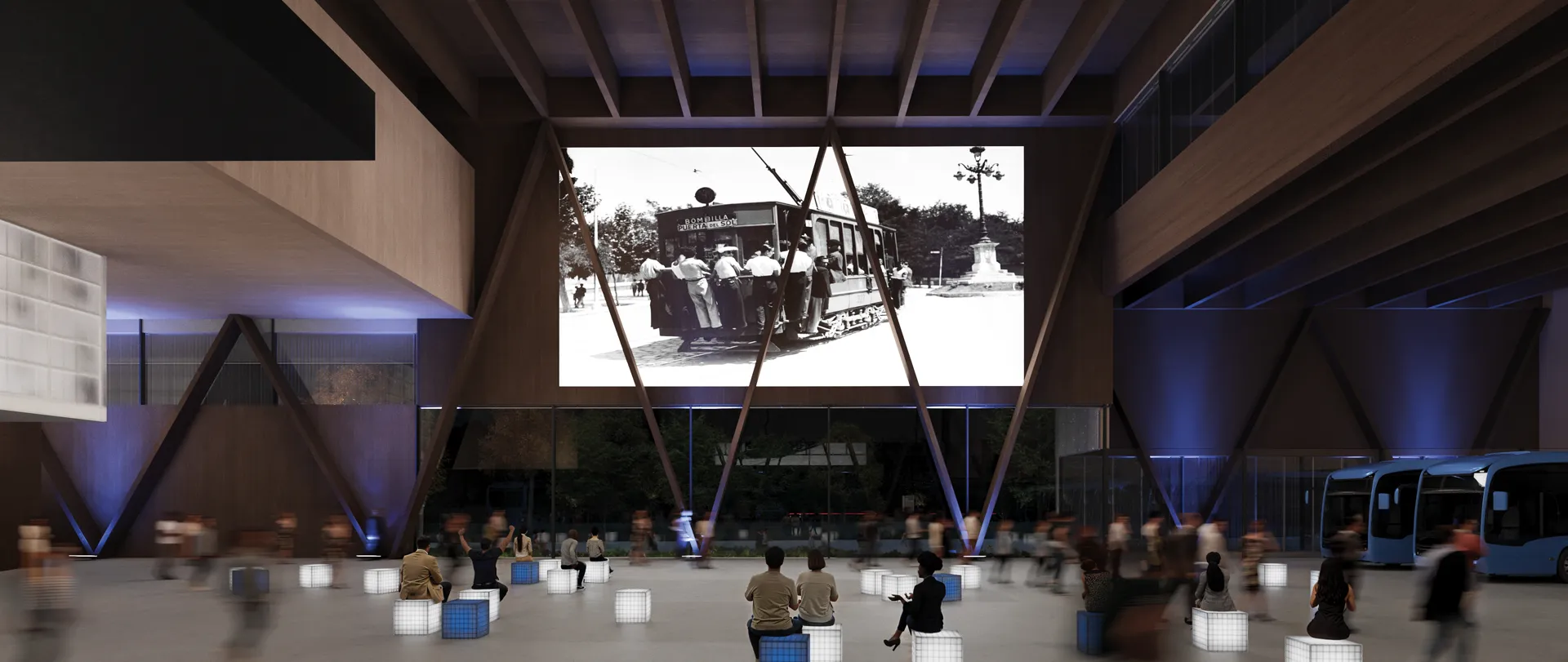
The spatial experience of the EMT Madrid Museum is organised as a continuous and accessible route that passes through the boxes, connects levels and generates cross-views between the different areas of the programme. The through-entrance hall, designed as a covered square, functions as a transitional space between the city and the park, and also as the main flow circulator. This central element articulates the ensemble and allows independent access to each box, reinforcing the perception of the museum as an open, permeable space connected to its surroundings.
Interior routes combine ramps, stairways and accessible vertical cores that connect all floors, including the basement exhibition spaces, which are illuminated by light wells. An external ramp connects the urban level with the interior of the building, allowing vehicle access and enriching the museographic sequence with a clear physical dimension, where slope, light and scale accompany movement and turn it into an experience. The general layout allows different ways of moving through the museum, adapted to different ages, times and abilities. Visitors can choose their itinerary according to their interests, without losing orientation or continuity. The boxes can operate autonomously, allowing simultaneous uses without interference. Integrated signage, smooth transitions and transparency between spaces construct a clear architectural narrative, in which movement is an active part of the content.
The museum proposes an inclusive experience, without physical or perceptual barriers. It offers multiple readings (chronological, thematic, technical or sensory), which turn movement into an opportunity for discovery, interaction and understanding of the urban context and the narratives that run through it.
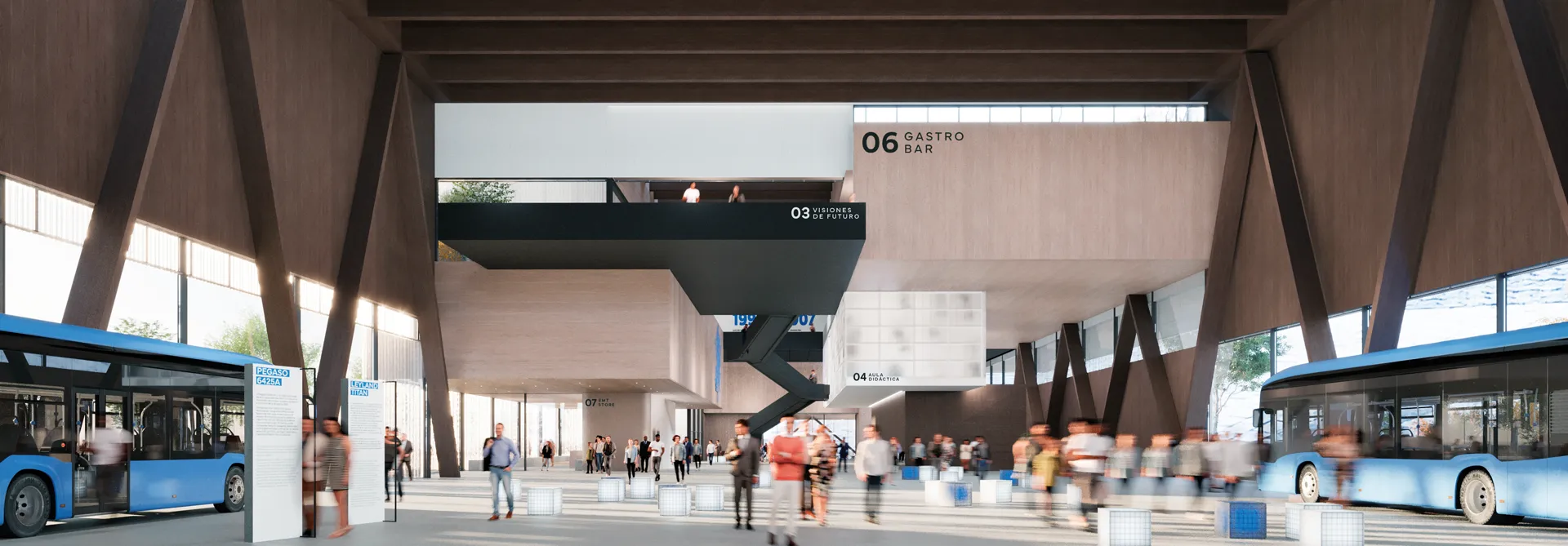
PROGRAMME AND FUNCTION
Functional, Connected and Adaptable Spaces
The museum is designed through a sequence of functional boxes arranged around a covered square that articulates access, routes and transitions between the city and the park. Each box responds to a specific use, with dimensions, access and materiality adjusted to its function, allowing both operational independence and spatial continuity.
The programme includes exhibition spaces (main and secondary), educational spaces, classrooms, leisure areas, a restaurant, workshops, offices and technical areas. This diversity is managed through a versatile distribution that allows alternative routes, simultaneous activities and programming adapted to diverse audiences. The boxes can be used autonomously or in combination, without interference, allowing flexible operation at different times or for different events. The exhibition spaces allow multiple configurations (linear, thematic or immersive), and the secondary boxes can change their use without altering the overall system. This capacity for adaptation reinforces the museum's evolving character as a living cultural infrastructure. The programme does not merely display content, but produces it: it includes spaces for the restoration and conservation of vehicles, a historical archive, an urban library and educational workshops linked to mobility and transport.
The architecture promotes the external activation of the EMT Madrid Museum, extending its use towards the park and the public space. Educational and cultural activities take place inside the building, but also in direct connection with its immediate surroundings. The museum acts as a civic, technical and educational platform, ready to incorporate new narratives and social dynamics.
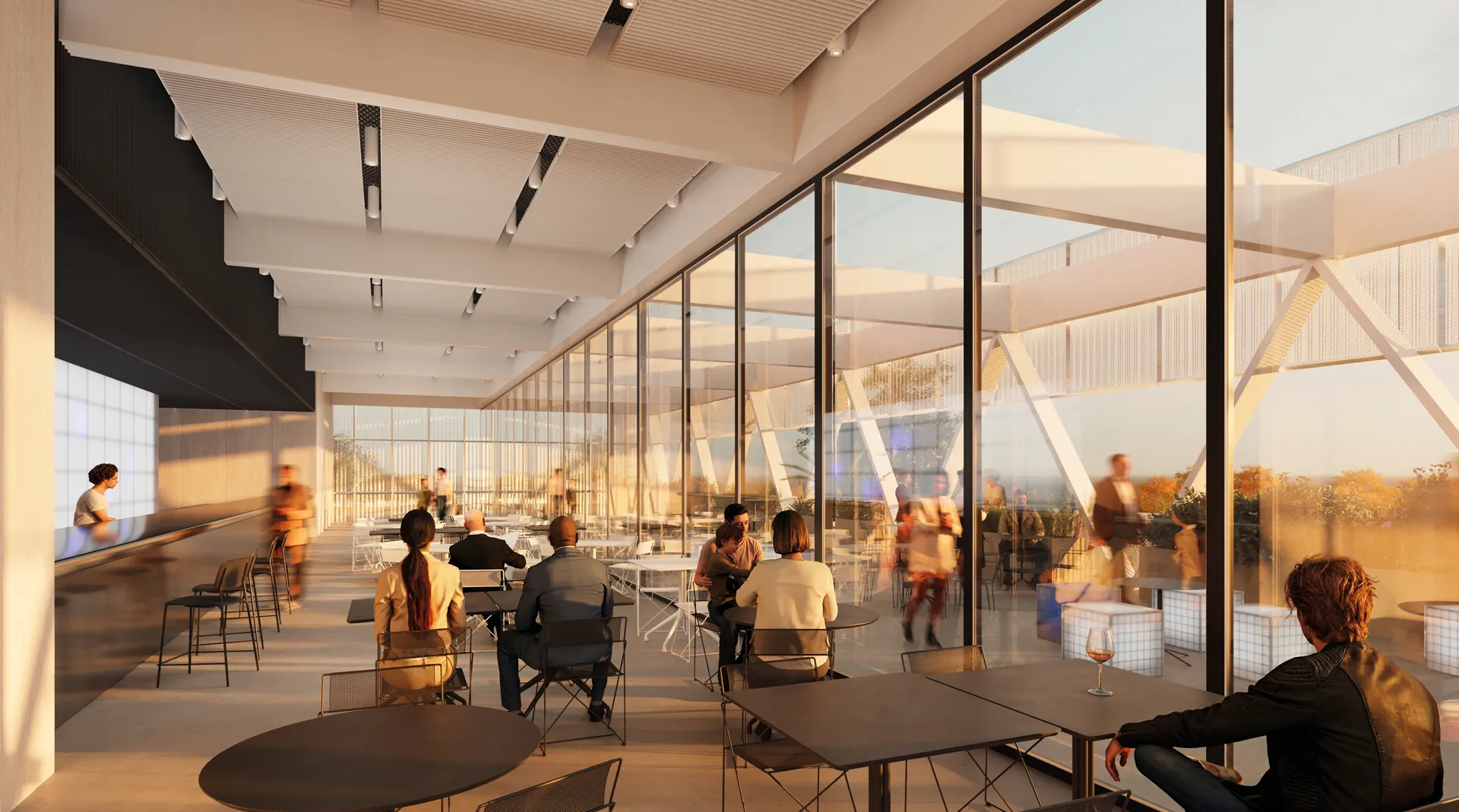
MATERIALITY AND CONSTRUCTION SYSTEM
Mixed Systems, Passive Sustainability and Architectural Expression
The construction of the museum responds to a dry, precise and modular logic that combines energy efficiency, architectural identity and material evocation linked to the industrial past of urban transport. This strategy allows for an optimised execution, with less waste generation and a high capacity for future transformation.
The envelope is conceived as a multi-layer system, in which a perforated metal skin acts as a solar filter and expressive element, anchored to an independent substructure that avoids thermal bridges. This layer projects variable shadows, protects against direct radiation and reinforces the urban reading of the building. Between both layers, a ventilated air cavity generates a chimney effect that improves thermal behaviour, especially in summer.
The structural enclosure, composed of cross-laminated timber (CLT) panels, integrates load-bearing, thermal and expressive functions, and adapts both to energy requirements and to the pedagogical narrative of the project. In the main areas, laminated timber beams span large distances, creating open, warm spaces that are structurally legible.
Interior finishes, selected according to use, combine resistance, acoustic absorption and visual warmth, reinforcing the visitor experience and guaranteeing durability in public environments. The architecture does not disguise its construction, but shows it as an active part of the exhibition content: material, technique and efficiency work together to define a contemporary, sustainable and expressive museum.
Each layer of this system responds to a precise constructive and climatic logic.
The key elements and their function within the overall system are summarised below:
Perforated Metal Skin
Micro-perforated metal sheet that protects from the sun and reinforces industrial identity. Regulates radiation, improves comfort and adds expressiveness.
Ventilated Air Cavity
Technical space of 6–10 cm that dissipates accumulated heat. Improves thermal performance and extends the lifespan of the enclosure.
Metal Substructure
Profiles with thermal break that support the skin without transmitting energy. Facilitate dry assembly, maintenance and structural efficiency.
CLT Structural Enclosure
Cross-laminated timber panels that insulate, support and define the character of the building. Reduce environmental impact and improve thermal performance.
Technical Interior Finish
Timber, phenolic or acoustic linings depending on use. Provide comfort, warmth and durability in high-traffic spaces.
Primary Laminated Timber Structure
Exposed beams spanning large distances. Combine lightness, structural expressiveness and sustainability.
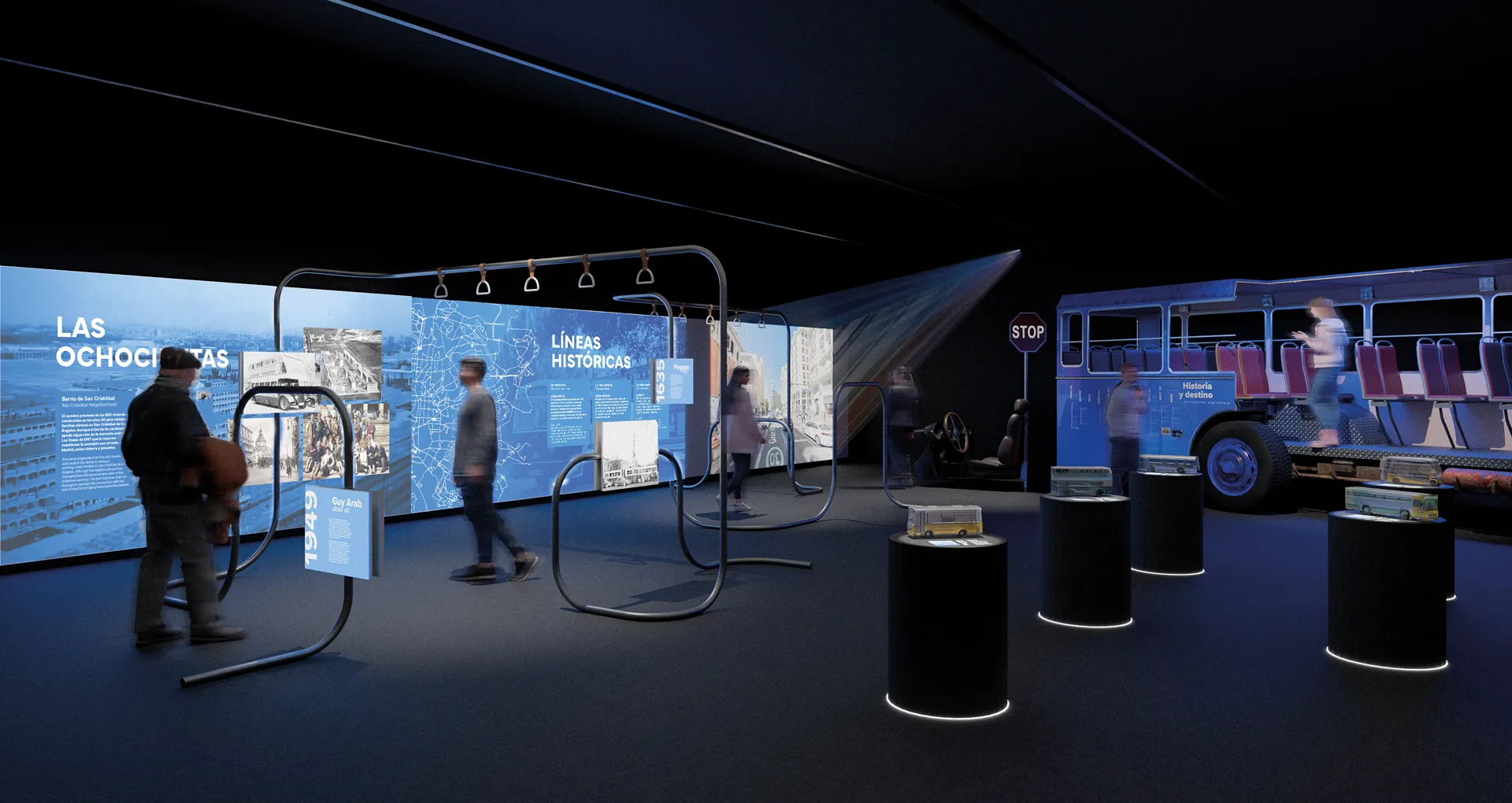
INTEGRATED MUSEOGRAPHY
The Building as Content, Narrative and Living Experience
The new EMT Madrid Museum proposal does not limit itself to exhibiting vehicles: it activates them as part of an inclusive, educational and emotional experience that connects city, history and people. Its museographic narrative is based on the human value of collective transport, recognising drivers, technicians and users as main characters of an evolving collective story. Each bus thus becomes a capsule of memory, and the museum a bridge between generations, territories and ways of life.
The exhibition spaces have been designed with criteria of modularity and dynamism. Electrified tracks, movable walls and reusable display elements make it easy to reconfigure the galleries, adapting them to temporary exhibitions, workshops or events. The museum is conceived as a living space, capable of accommodating different uses without losing coherence. Universal accessibility guides every design decision: from adapted sign design to the layout of the contents, all audiences find equitable ways of access. Wide, barrier-free routes, supported by adapted audio guides, tactile models, easy-to-read texts and Braille language, guarantee a diverse and complete experience. Accessibility is not limited to the physical dimension, but extends to understanding the discourse and full visitor participation.
Digital and sensory museography complements the physical exhibition: 3D models, videomapping, interactive interfaces and immersive rooms facilitate an expanded reading of the contents, without resorting to obsolete or exclusionary technological solutions. The integration of technology is conceived from the standpoint of durability, efficiency and pedagogy. Wellbeing is also projected into intermediate spaces: courtyards, green roofs and planted rest areas provide thermal comfort, environmental quality and moments of pause along the route. Museographic sustainability reinforces this approach, prioritising the reuse of exhibition structures, the use of eco-textiles, modular display cases and efficient, programmable lighting.
The EMT Madrid Museum is not only visited but also inhabited. It hosts educational activities for diverse audiences, extends its functional programme into the urban space, and fosters an emotional and cultural connection with the public. It is an open infrastructure that informs, engages and remains in motion.
INVESTMENT STRATEGY
Investment Aligned with Urban, Technical and Social Impact
The investment strategy of the EMT Madrid Museum responds to a logic of long-term technical, functional and cultural impact. Each budgetary decision prioritises durable, efficient and versatile solutions capable of reducing future costs, facilitating maintenance and generating added value, both architecturally and socially.
A mixed construction system (laminated timber, metal structure and concrete) has been chosen, combining expressiveness and economy. The ventilated envelope, CLT enclosures and intelligent management systems make it possible to reduce emissions, waste and energy consumption from the outset. Museography and technology are integrated as strategic, not decorative, chapters, reinforcing the museum's educational and transformative role.
From the preliminary works to the final installation of the museographic equipment, the project is organised into technical chapters with differentiated weightings. This approach facilitates schedule control, dry execution and the possibility of future growth without altering the logic of the overall scheme.
Architect
Ramón Esteve
Collaborating Architects
Anna Boscà
Beatriz Martín
Germán Bataller
Jorge Contreras
Visuals
Tudi Soriano
Guido Bolognini
David Baños
REE Collaborators
Carolina Ugarte Onuluk
Carlos Linares
Engineering
LEING
Museography
Rocamora